Why Is Yarra Valley Famous?
The Yarra Valley is famous for Victoria's first vineyards, a mid-century collapse, a 1960s revival, and a cool-climate reputation built on Pinot Noir and Chardonnay. Here is the history behind the fame.
Why Is Yarra Valley Famous?
The Yarra Valley is famous for three things stacked on top of each other: it holds Victoria's first known vineyard, planted in the late 1830s; it is the cool-climate region that Australia's winemakers revived from nothing in the 1960s; and its Pinot Noir and Chardonnay now rank among the country's most awarded wines, with the region supplying 23 per cent of the national Chardonnay crush. Few wine regions anywhere have a story with a genuine ending and a genuine second act. This one does, and the gap between the two acts, roughly three decades with almost no vines, is the part most brochures skip.
The fame is not only about wine. The valley is also the day-trip country for Melbourne, about 51 km by road from the CBD to Coldstream, and it carries the wildlife, ballooning and food credentials that most wine regions have to borrow from somewhere else. Healesville Sanctuary sits inside the region's best-known town, and the Helmeted Honeyeater, Victoria's bird emblem, survives because of a breeding program there.
But the core of the fame, the reason the name carries weight with people who care about wine, is the history. It is a story of Swiss vignerons, a depression-era collapse, and a second generation of winemakers who bet that a cold, wet valley an hour from Melbourne could make fine wine when almost nobody else in Australia was trying.
For visitors who want to taste the story rather than read it, three tours cover the valley's famous sides well: the wildlife-and-wine angle, the sunset version, and the private, build-it-yourself day.
Where The Fame Began: The First Vines In Victoria
Heritage Victoria's statement of significance for Chateau Yering, originally Yering Station, says it was "the first known vineyard in Victoria, vines having been planted there in the late 1830s." The property was established by settlers William Ryrie and his brothers Donald and James, and with the help of Swiss vigneron James Dardel, William Ryrie is also thought to have produced the first wine made in the state. Those hedges, "first known" and "thought to have", are not caution for its own sake: the institutional record genuinely does not support a more precise date, and the association's marketing timeline is the only place that prints one outright.
The valley's early fame was real and international. Paul de Castella purchased Yering in 1850 and developed it into a large and successful vineyard, and Heritage Victoria records that for most of the 19th century Yering was the largest vineyard in the Yarra Valley. The Australian Dictionary of Biography adds the scale: the station's 30,000 acres included a vineyard of about ten acres planted by the Ryries, and de Castella arrived in Melbourne in November 1849 to build on it. Neighbouring estates followed, and the region's name was appearing on wine sent to exhibitions in Europe.
What makes this history famous rather than merely old is what happened next. The vines came out. Economic depression, changing tastes and phylloxera-era economics pushed the valley's growers to convert land to grazing, and by the late 1930s the region that had produced Victoria's first wine had effectively stopped making wine at all. Wine Australia's own education programme calls the region "the tale of two beginnings", with a rich viticultural history followed by "a fresh start in the '70s". That gap, decades with essentially no commercial viticulture, is nearly unique among famous wine regions. Most old regions claim continuity; the Yarra Valley's claim is resurrection.
The place where the story started is still standing. Chateau Yering is on the Victorian Heritage Register as H1139, covering the homestead, stables, winery and a shed, and a hot air balloon flight over the valley departs from the hotel grounds, which is one of the more agreeable ways to see the landscape that first made the region's name. The Yarra Valley Wine Tours guide to the region's wineries covers what grew back on that same ground.
The Revival: How A Forgotten Region Became Famous Again
The Yarra Valley's second act began in 1963 with Wantirna Estate, the first of the new generation, followed between 1968 and 1975 by Yarra Yering, Mount Mary, Fergusson, Seville Estate, Warramate, Yarra Burn and the property that became De Bortoli, with Yeringberg and St Huberts re-established in the same wave. Those are the claims of the region's own association timeline, and they describe a remarkable concentration: within about a dozen years, a wine region that had been written off was replanted from scratch by a handful of families whose names still dominate its trophy lists today.
The bet those pioneers made was cool climate. The valley is genuinely cold for Australian winegrowing: mean January temperature for the region is 19.9 degrees C on the 2006-2025 average, calculated across the whole geographical indication, against the 1961-1990 average of 18.3 degrees C. Wine Australia's snapshot publishes those figures with their averaging periods, and the region's growing season rainfall, 607 mm in the 2025-26 season, calculated October to April, tells you what the pioneers were signing up for. In a country whose wine fame was built on warm-climate Shiraz, they planted varieties that Australia had largely ignored.
The revival's success is now measurable, and the measurement is the best evidence of the fame. The region's estimated 2026 crush was 6,766 tonnes, a small crop by national standards, and its fruit sells for roughly four and a half times the national average per tonne. The 2026 national vintage was the smallest in 25 years, and the Yarra Valley's own crop fell 31 per cent in a single year after a season one veteran winemaker described as second only to 2011 as the most challenging he had worked. Yet the price of what the region exports rose 10 per cent to $21.07 a litre. Scarcity plus quality is the classic recipe for a famous name.
Reading the numbers is one thing; standing in the vineyards that produced them is another, and the revival's story is easiest to absorb on a guided day that moves between the old estates and the new. If the history is what draws you, the afternoon wildlife-and-wine tour below is a good way to see the valley's two claims to fame in one booking, with free cancellation if plans change.
The Wine Reputation: Pinot Noir, Chardonnay And The Trophies
The Yarra Valley is famous among wine drinkers for two varieties above all: Pinot Noir, which took 44 per cent of the region's 2026 crush and produced the 2025 Australian Pinot Noir Challenge trophy winner, and Chardonnay, which took 30 per cent of the crush and gave the region 23 per cent of Australia's entire national Chardonnay tonnage. Sparkling is the region's quieter third claim, built on the same two grapes, and the region's show results now read like a roll call of the revival's descendants: in the 2027 Halliday awards alone, a Yarra Valley wine took Wine of the Year and a Yarra Valley winery took Best Value Winery.
The variety mix matters because it explains the style. This is not a big, warm, fortified-wine region; it is a place where the country's winemakers learned that Australia could make fine Pinot Noir at all. The trophy record backs that up with names and scores: Mount Mary Pinot Noir 2023 was Halliday Pinot Noir of the Year in the 2026 edition at 98 points, and Yarra Yering Dry Red Wine No. 1 2023 took Cabernet and Blends of the Year at 99 points. The Real Review named Yarra Yering its Winery of the Year Australia for 2026, the producer's third such title.
| Variety | Share of the 2026 Yarra Valley crush | What it means for the region's fame |
|---|---|---|
| Pinot Noir | 44 per cent | The signature red; national trophy winner in 2025 |
| Chardonnay | 30 per cent | 23 per cent of the national Chardonnay crush |
| Shiraz | 8 per cent | The warm-climate variety, grown here in a cooler style |
| Cabernet Sauvignon | 5 per cent | Historic variety, still winning trophies in blends |
| Pinot Gris/Grigio | 4 per cent | The rising white behind the big two |
One honest caveat belongs in any account of the fame: no Yarra Valley winery has been named Halliday Wine Companion Winery of the Year in either of the last two editions, with those titles going to Brokenwood in the Hunter Valley and House of Arras in Tasmania. The region's wins sit in the wine, value and variety categories. That is still a strong record, and it is the kind a reader can actually check, which is more than most wine-region fame can say. If you want the full picture of which bottles to look for, the guide to the best wines from the Yarra Valley works through the current trophy winners variety by variety.
Beyond Wine: The Wildlife, Balloons And Food That Widened The Fame
The Yarra Valley's fame widened beyond wine through Healesville Sanctuary, home of the breeding program that saved the Helmeted Honeyeater, Victoria's bird emblem, and through sunrise ballooning over its vineyards, a bookable, award-recognised product. Its food scene also drew wider attention. At the 2025 Victorian Tourism Awards, decided 3 December 2025, Yarra Valley operators took medals across culinary excellence, hosted accommodation, tour and transport and adventure tourism, four independently judged results that show the region sells more than a cellar door experience. The food side of the fame, from orchards to cheese makers, rounds out a region that would be a destination even without a single vine.
The wildlife side of the fame is genuinely significant. In May 2025, 21 Helmeted Honeyeaters bred at Healesville Sanctuary were reintroduced to Cardinia Creek near Upper Beaconsfield, an area the critically endangered species had not occupied for more than 40 years, establishing a third wild population. Stage one of the Australian Platypus Conservation Centre, a rehabilitation facility with nine connecting ponds, opened at the sanctuary in July 2025. And the sanctuary sits inside the region's best-known town, which means a wine day and a wildlife day can be the same day.
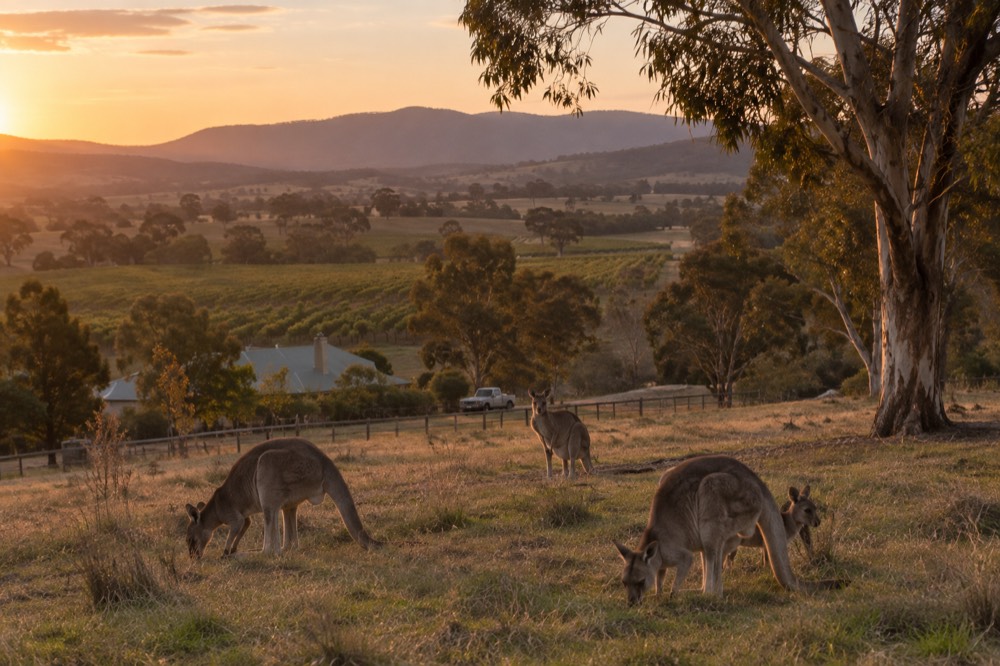
That combination, wine plus wildlife, is unusual enough that several tours are built entirely around it. The afternoon tastings tour pairs stops at Coldstream Dairy, Domaine Chandon, Yering Station and the Chocolaterie with kangaroos at dusk, and it is the most direct way to see both halves of the valley's fame in a single afternoon.
The ballooning half is anchored by the landscape itself: the valley's flat floor and morning mists make it one of Australia's classic balloon regions, and the Chandon, sunset kangaroo safari tour covers the sparkling house, Yering Station and a wildlife stop in one small-group day. For readers weighing the flight itself, the write-up on whether a Melbourne hot air balloon is worth it covers the honest safety and value questions.
How To See The Famous Valley In A Day
Most visitors experience the famous Yarra Valley as a single day trip from Melbourne, since Coldstream, the heart of the cellar door cluster, is about 51 km and under an hour's drive from the CBD at free-flow speeds, and the standard tour day runs 7 to 10 hours with hotel pickup. The fame is dense enough that one well-chosen day can touch the history, the wine and the wildlife, but the shape of the day matters more here than in most regions because the valley is long and the stops are spread along it.
A day built around the region's fame usually runs in one of two shapes. The wine-first shape spends the morning at two or three cellar doors, lunch at a winery restaurant, and an afternoon at a fourth stop, which is the pattern of the classic full-day tours. The story-first shape front-loads the history and scenery, Chateau Yering or a balloon flight, and finishes with tastings, which is where the private options shine.
The build-your-own private winery day is the most flexible version of the second shape: it runs about 8 hours with hotel pickup, and because you choose the stops, it is the one format where you can deliberately build a day around the region's history, from the old Yering country, where Heritage Victoria records the first known vineyard in Victoria, planted in the late 1830s, through to the modern icons of the revival.
Whichever shape you choose, two practical points carry the fame intact. First, drink-driving law is the honest reason the driven tour exists: Victoria's limit is 0.05, and the offence is committed at 0.05 or more, with automatic three-month cancellation for a first low-range infringement. Second, the valley's cellar door landscape changed materially in 2025, with closures and openings in Healesville and Coldstream, so a current tour stop list is worth more than an old blog itinerary. The day-by-day wine tour itinerary guide keeps the sequencing current.
If a single afternoon is all the time allows, the trio below covers the three most famous angles of the valley: wine with kangaroos at dusk, the sparkling house and safari combination, and the private build-your-own day.
Common Questions
Why Is Yarra Valley Famous?
It is famous as Victoria's oldest wine region, home to the state's first known vineyard, planted in the late 1830s, and as the cool-climate region revived from nothing in the 1960s whose Pinot Noir and Chardonnay now win national trophies. Its fame also draws on Healesville Sanctuary, sunrise ballooning and its role as Melbourne's wine country.
Is the Yarra Valley actually worth visiting?
Yes, and the demand is measurable: the Yarra Ranges Council region accounts for 6.3 per cent of all day trippers across Victoria, up from 5 per cent in 2018-19. Four Yarra Valley operators won or placed in categories at the 2025 Victorian Tourism Awards, decided 3 December 2025.
What wine is the Yarra Valley most famous for?
Pinot Noir and Chardonnay. Pinot Noir took 44 per cent of the region's 2026 crush and Chardonnay 30 per cent, and the region's Chardonnay was 23 per cent of the national Chardonnay crush. Giant Steps' 2024 Applejack Vineyard Pinot Noir won the 2025 Australian Pinot Noir Challenge trophy.
When were the first vines planted in the Yarra Valley?
Heritage Victoria says vines were planted at Yering, now Chateau Yering, in the late 1830s, making it the first known vineyard in Victoria. The precise year 1838 appears only in the regional association's marketing timeline, not in the institutional record.
Did the Yarra Valley ever stop making wine?
Yes. In the depression years the vineyards were converted to grazing land, with the association's timeline dating the conversion to 1937, and the region had essentially no commercial viticulture until Wantirna Estate replanted in 1963, beginning the second wave of plantings between 1968 and 1975.
Can you see kangaroos and wine country on the same day?
Yes, and several tours are built around it. The afternoon tastings tour visits Coldstream Dairy, Domaine Chandon, Yering Station and the Chocolaterie and finishes with kangaroos at dusk, running about 7 hours from $143.2.